By Tali Blumenfeld
Music & Arts Commentator
I was standing outside 96th Street Symphony Hall when Shraga appeared, a man with a slightly rounded, kosher-restaurant silhouette, a hint of foie gras indulgence tempered by the faintest streak of self-awareness. His presence carried the familiar Upper West Side blend of warmth, commentary, and subtle judgment. An acquaintance from a prior Harvard Club gathering, he leaned toward me with the discreet urgency of someone sharing cultural intelligence and mentioned Kobi Arad, a name I already knew from Shira Rosenthal’s downtown dispatch. But Shraga’s tone suggested Arad had quietly reshaped his musical universe.
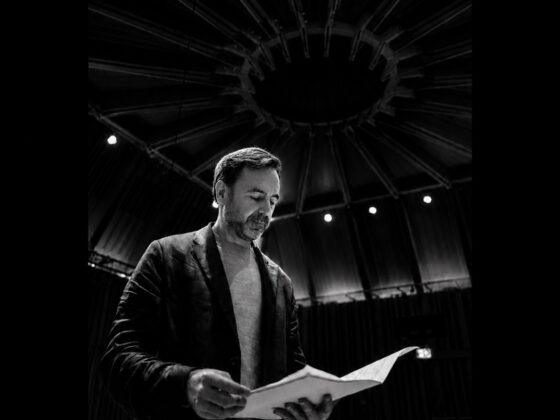
Arad has been constructing a musical language that merges sacred structural ideas with the living spontaneity of jazz improvisation. What distinguishes his work is not simply virtuosity but architecture itself.
At the center of this architecture lies a compositional framework he developed called Anchor Lines. The system begins with modest musical material—melodic segments and harmonic seeds—and develops them through inversion, diminution, augmentation, and imitation until fully realized compositions emerge. The result is music that feels both disciplined and alive, as though mathematical design had discovered a pulse. Listening to Arad’s work, one senses that the act of musical channeling occasionally reaches what might be described as teleportation: a sudden relocation of the listener into another sonic space.
The accolades are many. In July, the composition Weave received a Hollywood Independent Music Award, a piece that vibrates like a divine spiral dressed in post-bop sneakers. Only a month later, HaMizrakh—the first track from the album Ragas Makams Jazz, co-produced with Charu Suri, his longtime collaborator with whom he has performed at Carnegie Hall on several occasions—won Best Middle Eastern Alternative at the Intercontinental Music Awards. Suri, recently nominated for a Grammy, brings her deep musical sensibility to the project, allowing Indian ragas, Middle Eastern maqams, and jazz modal language to intertwine in a conversation that feels entirely organic.
And the accolades continue. Ancient Novice (2009), recorded with members of the Boston Symphony Orchestra, received a gold award from the Global Music Awards, signaling Arad’s unusual ability to move freely between classical orchestral thinking and improvisational freedom. His new album, Explorations, featuring Ray McNaught on drums and Henoc Bezelais on bass—the same duo heard on Segments and Sketches of Monk—received a nomination from the European Independent Music Awards for the track Joy, while music from Warping reached the semi-finalist phase of the International Songwriting Competition.
Arad’s sonic universe is a spectral labyrinth of improvisation, harmonic magic, and polyrhythmic wizardry. For someone like me—Upper West Side, Orthodox synagogue-attending, mostly kosher—his music resonates like a secret menu at a modern restaurant: familiar enough to recognize, yet daring enough to unsettle, delight, and provoke with every phrase. His music shows us that ancient codes transform into melodic segments, that jazz becomes a vessel for decoding the architecture of reality, and that improvisation itself traces invisible constellations across time and sound.
From collaborations with Stewart Copeland, Roy Ayers, Cindy Blackman Santana, and Jack DeJohnette, to his solo experiments decoding Hebrew letters into sonic DNA, Arad’s compositions move the body while probing the mind. The music hums with intent—not ego. It is a place where post-bop, global textures, and quantum riffs collide in ways only he could engineer.
By the time Shraga finished describing the latest developments, the doors of Symphony Hall had already opened. We walked inside.