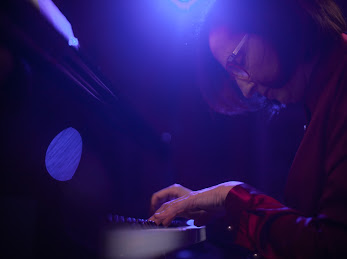
You are Sicilian. How much of that culture is woven into your music?
When you are born on an island, the essence of that island—with its quirks, contradictions, analogies, injustices, humanity, enigmas, and landscapes—becomes ingrained in your very being. It’s an inescapable truth. Upon leaving Sicily, the memories of that land crystallized into sensations: scents, flavors, sounds. That Sicilian reality, drenched in grief and brimming with unanswered questions, alongside its striking beauty, resides within you. You translate it into melodies, songs, or acts of defiance, only to intermittently flee, sometimes with a forceful exit. Sicily stirs something deep inside you, compelling a certain distance. Music becomes the ideal “bridge.”
When composing, do you adhere to a specific method or create spontaneously?
My creative process is always unique: at times, I find myself taking mental notes, humming fragments of melodies, unsure of their final form. I extract these notes thoughtfully, layering them, allowing them to coexist, blending them until they find an identity. When they solidify, they awaken, often taking a direction different from my initial vision. Music is inherently unpredictable; one might attempt to mold it, yet ultimately, it evolves with its distinct character. Composing embodies the Socratic acknowledgment of “I know that I do not know.” I have self-awareness, but the music remains a mystery. Occasionally, I can craft intricate pieces swiftly, while at other times, relatively straightforward compositions demand intense effort. In essence, music exists in a realm where simplicity becomes elaborate and profound, leading you into uncharted paths of discovery. It is in this space that one glimpses infinity. Composing also requires physical energy, as one liberates those “notes,” those elements that dwell within, circulating through the body, resulting in a process of release and purification that opens up space for new “creations” yearning to come into existence.
What is your connection to reality, particularly young people, and what unique role can music play?
My engagement with the world beyond music holds significant importance. I’m curious, there exists a significant interest in comprehending both the world and the perspectives of others, particularly among young individuals. Their embodiment of changing and evolving realities, along with their fresh outlook and openness to the world, presents an intriguing subject of music source. We are dynamic beings, both spiritually and physically, perpetually influenced by change. It is our responsibility to grasp the richness of this transformation. Music has the potential to catalyze our metamorphosis.
What significance does the contemporary composer hold today?
In today’s world, a composer often begins to gain recognition posthumously, a rather disheartening reality. We honor and cherish the past, which is essential, yet we find ourselves in an era where the present is often overlooked. Listening demands time, presence, and focused attention, making it challenging to connect. Composing has become an abstract, seemingly irrelevant pursuit, where self-expression without support feels like a mere ripple in an expansive ocean. However, it is precisely within that ocean that a composer thrives, and ultimately, one cannot exist without it.
A perspective on the world. How do you perceive it?
People align themselves with their fears. You can observe how the wise and the just unite in rational fear, while the deceitful and the malicious come together in a misguided fear. Humanity is divided by agreements and alliances formed in response to these fears. Music and art serves as tools to liberate us form this anxieties; they represent a commitment against the false established system or at least is what I believe.
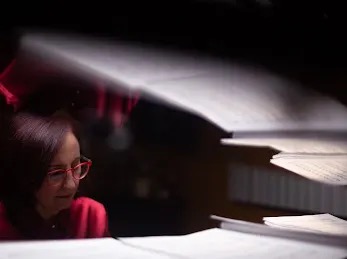
What is the significant experience you remember with particular emotion?
I would say many, as each experience represents a moment of unique growth and discovery. However, I particularly recall the first time I met Judith Malina and The Living Theatre, the oldest experimental theater company in America. At that time, I was living in Italy, and they were touring Europe, though they had spent an extended period in Italy, in Rocchetta Ligure. I met Judith Malina and Hanon Reznikov, two remarkable artists, who asked me to compose the stage music for a performance against the death penalty titled The Last Fire. I was both thrilled and intimidated by that request. The performance was unforgettable, filled with emotion and intensity. Judith Malina’s approach to theater was prophetic, and became a symbol of radical theater.
What adjective would you use to describe your music?
Perhaps, passionate.
Thank you for this conversation.
Thank you for the opportunity.
Maria Rago’s reflections illustrate an approach to art that is profoundly rooted in human experience, encompassing memory, spirituality, and a courageous engagement with truth. Her music transcends mere composition; it is shaped, refined, and revitalized through lived experience. As our discussion concludes, it is evident that Maria Rago composes not just for the present moment but for the essence of the soul, producing works that resonate well beyond auditory experiences, touching upon the fundamental aspects of humanity.